
Why you need to implement PAiMM™ in your organization
AI is not a fringe technology like crypto or NFTs—it is a workplace transformation, where every employee needs a path to fluency
Executive summary: Treating artificial intelligence as optional “innovation theater” is the fastest way to fall behind. AI is not a fringe technology confined to enthusiasts—the way blockchain speculation, crypto trading, and NFT collectibles largely remained. It is a fundamental shift in how work gets done, and it demands the same organization-wide response you would have given the personal computer and the Internet when those waves arrived. The Progressive AI Maturity Model (PAiMM™) exists so you can implement that response deliberately: measurable stages, role-by-role expectations, and productivity gains you can defend to the board—not ad hoc tool rollouts with no finish line.
This is not fringe technology
Fringe waves share a pattern: intense hype, a narrow participant base, and unclear obligation for everyone else. Most employees could ignore crypto wallets and NFT marketplaces without impairing their jobs. Generative AI is different. It touches writing, analysis, code, customer response, forecasting, and coordination—the daily fabric of knowledge work. When a capability lands that broadly, the question is not whether your company will use it; it is whether you will standardize fluency or let proficiency scatter by individual curiosity and manager tolerance.
A fundamental shift in the workplace
Fluency does not mean everyone becomes an engineer. It means people in every function know when to reach for AI, how to verify outputs, how to combine human judgment with machine speed, and how their role advances on a shared maturity curve. That is an HR, operations, and leadership problem—not a sandbox reserved for “digital natives” or a volunteer guild of power users. Organizations that wait for enthusiasm to spread organically will discover, too late, that competitors institutionalized skills, guardrails, and workflows while they were still debating pilot access.
We have seen this movie twice before
In the last forty years, the workplace transformed twice at comparable scale. First, the personal computer moved computing from the data center to the desktop—suddenly every analyst, clerk, and manager was expected to work digitally. Later, the Internet rewired communication, research, commerce, and collaboration; fluency with email, browsers, and online services became table stakes. Leaders who treated those shifts as IT projects lagged. Leaders who treated them as workforce transformations—training, standards, hiring, performance expectations—captured the upside.
AI is the third wave. The timeline will feel faster because the tools improve monthly and the cost of experimentation is low. The obligation is the same: define what “good” looks like at each level of the organization, fund enablement, and measure movement—not whether one team bought a copilot license.
The quest to become AI-native
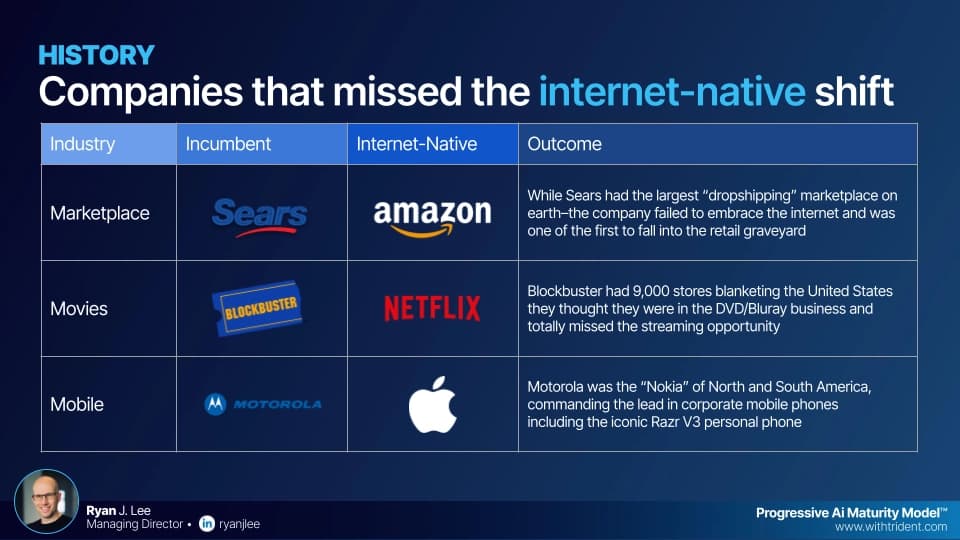
Becoming AI-native is not a branding exercise. It is the same class of bet leaders faced when society and the workforce reorganized around marketplaces, then the open web, then mobile—only faster. History is littered with incumbents that owned the old model, mastered its operations, and still lost to a native entrant because they treated the shift as optional. Three cautionary arcs capture that pattern: marketplaces, movies, and mobile phones.
The largest marketplace
In the 1970s, 1980s, and 1990s, Sears was the largest marketplace on the planet. The catalog was the discovery engine. The store network was the fulfillment layer. Sears had effectively mastered dropshipping logic before the term was fashionable—vast supplier networks, national reach, and trust built over generations. If you were teaching “multi-sided commerce” in 1985, you would have used Sears as the case study.
Then an internet-native company arrived. Jeff Bezos’ Amazon was pilloried and parodied in the media—a bookstore on the web, absurd to incumbents who already sold everything. Sears had the assortment, the logistics relationships, and the brand. What it did not treat as urgent was a new native form factor for how buyers discovered, compared, and purchased. Amazon did not win on day one. It won by compounding digital selection, price transparency, and execution until the old marketplace model looked like legacy infrastructure.
The ending is familiar: Amazon eclipsed Sears and eventually rocketed to a valuation on the order of three times the incumbent superstore benchmark—Walmart—while Sears became a cautionary footnote. The lesson is not “be more like Amazon.” The lesson is that owning the previous wave’s playbook is not sufficient when the workforce, customer behavior, and technology shift underneath you.
The way we watched movies
Blockbuster was a near monopoly across the United States—difficult to displace. The next-largest competitors were regional chains at best, followed by a long tail of mom-and-pop shops. Blockbuster rested on its laurels, commanding a lead in the competitive landscape that looked permanent. At its peak, the company operated more than 9,000 stores nationwide.
Then an internet-native Silicon Valley startup appeared with mail-order DVDs, and later streaming. The industry laughed. Early streaming catalogs were thin—easy to dismiss. The rumor was that Blockbuster could have acquired the company for on the order of $10–20 million. Instead, leadership dug in and decided they were in the DVD and Blu-ray business, not the convenience-and-selection business customers were already moving toward.
Today, only one Blockbuster store remains in the United States—a nostalgia landmark from a footprint that once blanketed the country. The strategic failure to become internet-native did not leave Blockbuster wounded; it erased the brand as an operating force. Not even the romance of excitedly browsing new releases on a Friday night could keep the model on life support.
The original mobile trendsetter
Motorola was riding high at its peak. The company had just released the Razr V3—a design object as much as a phone. You could buy it in a spectrum of finishes, from black to pink. Celebrities were photographed with it everywhere; for a moment, Motorola owned the cultural signal for what “mobile” meant.
Then the industry pivoted again. Motorola’s failure was not bad industrial design—it was not treating the device as a portal into an internet-native ecosystem. Apple and Android did. They shipped platforms, app economies, and always-on connectivity that made the phone the front door to the web—not a flip phone that happened to make calls. The incumbents who mastered the previous form factor lost to internet-native companies that sold a window into what came next.
The layoff concern
After stories like these, executives often ask the quiet question: Will AI mean layoffs? The honest answer is more nuanced than “robots replace humans.” What disappears first is not the job category—it is the unassisted version of the job. Organizations still need accountants, analysts, marketers, and operators. They need fewer people who cannot use the new productivity layer to do the same work at the speed the business now expects.
Accounting is the clearest analogy from the spreadsheet era. The profession did not vanish when T-accounts and paper ledgers gave way to Lotus 1-2-3 and Excel. Firms still hired accountants—but fluency with spreadsheets became the baseline. People who could model scenarios, reconcile faster, and serve more clients with the same headcount won the next promotion cycle. People who treated the spreadsheet as optional—real accounting happens on the green sheet—found themselves unable to compete in the same seat. The role endured; the pre-spreadsheet workflow did not.
The Internet repeated the pattern for retail travel agents. For decades, storefront agencies held exclusive access to reservation systems and fare rules. When comparison sites, self-service booking, and transparent pricing became normal, “book me a flight” was no longer a defensible monopoly. Complex itineraries, advocacy, and high-touch travel still required humans—but agents who refused to work internet-native lost relevance while peers used the web to multiply reach. Many careers continued; the default storefront-only model dried up.
AI is the same class of shift, only faster. The risk is not a machine with your job title on the door. The risk is colleagues at the same level who supercharge output with AI fluency—more analysis, faster drafts, tighter code review, sharper forecasts—while others produce at last decade’s pace. Implementing PAiMM™ is not a headcount-reduction program dressed as innovation. It is how you make fluency explicit so the gap does not become an unspoken layoff by attrition: keep the people, equip the workforce, and raise the bar together.
The future of work for technology and product
At two recent conferences, I had the chance to present PAiMM™ to rooms full of engineers, product managers, and leaders. The questions were sharp—not skepticism for its own sake, but people trying to map the framework onto how their orgs actually ship. One engineer put it plainly: “So for software development in today’s world we have one product manager and five engineers. In the future, are you saying we’ll only need a single product manager to prompt to production?”
My answer: you are directionally correct that the traditional five-engineer pod thins out—but the future is not one heroic PM with a chat window. We do our best work with diverse teams. Prompt-to-production removes a lot of boilerplate, scaffolding, and translation layers; it does not remove business judgment, data and platform integrity, or market positioning. What you get is a smaller, higher-leverage trio—each role carrying a different slice of accountability:
- Product Manager — owns outcomes and business context: customer problem, success metrics, tradeoffs, and what “done” means for the business
- Technical Product Manager — owns the technical shape of the solution: data architectures, integrations, platform constraints, security boundaries, and what is safe to automate versus what still needs human review
- Product Marketing Manager — owns how the product is understood and adopted: positioning, narrative, launch motion, and feedback loops that steer the roadmap toward real demand
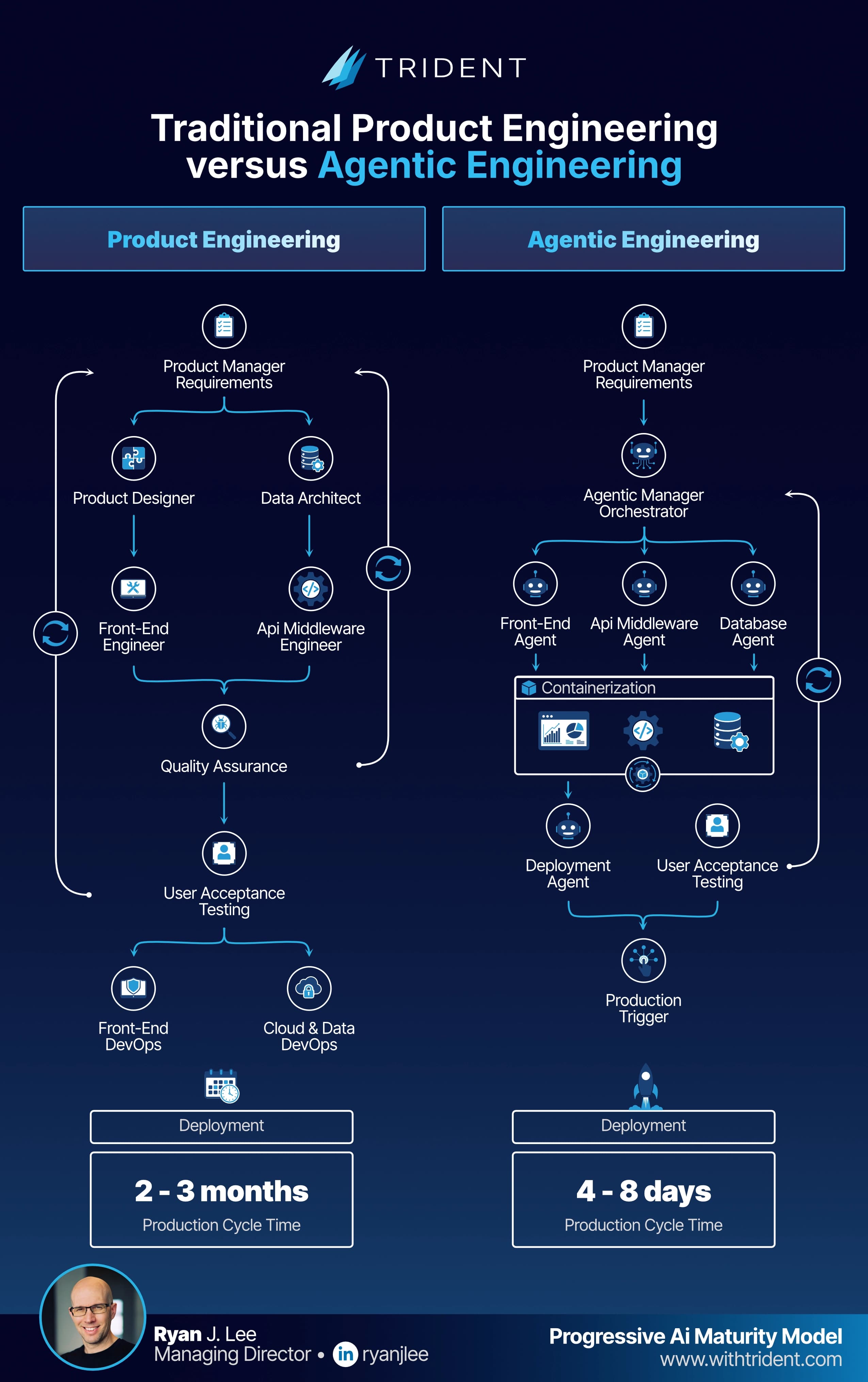
Think of it as compression without collapse. The old model spread the same decision across handoffs—spec, ticket, sprint, review, release notes—because each step needed a different specialist to move bits. AI-native workflow collapses execution, but it amplifies the cost of weak judgment at each layer. A PM who cannot read a P&L still cannot prioritize. A TPM who does not understand lineage and access patterns still cannot ship safely. A PMM who cannot articulate differentiation still cannot win attention in a crowded category.
That is why PAiMM™ is staged by function, not “everyone learns the same prompt tricks.” Maturity expectations differ for the PM who frames the bet, the TPM who hardens the path to production, and the PMM who closes the loop with the market. The workforce does not shrink to one seat—it recomposes into fewer seats with clearer mandates. Organizations that plan for that trio early will ship faster than rivals still staffing five engineers to translate what one fluent team already knows how to say.
Business at the speed of thought
The upside of the last three waves was never “fewer people.” It was more throughput per person—ideas tested faster, decisions informed sooner, customers served without waiting on manual bottlenecks. AI is the first wave where that compression is visible in knowledge work itself: draft, analyze, compare, and iterate at the pace you can think, when your team knows how to wield today’s tools with judgment and guardrails.
That is the call to action for leadership: equip your team with AI fluency so they are not guessing their way through prompts or hiding behind pilots. Fluency protects career relevancy inside your walls—the same way spreadsheet and internet skills once separated people who led workflows from people who were bypassed by them. It also protects the business: competitors who institutionalize fluency will operate at a cadence your unassisted processes cannot match.
PAiMM™ is how Trident helps you get there deliberately—stages, role expectations, and enablement you can measure—not a license dump and hope. The goal is business at the speed of thought: your people sharp enough to use AI as leverage, your organization fast enough to act while the insight is still fresh. Start with the framework and masterclass in curated reading below, or talk to us about mapping PAiMM™ to your functions this quarter.
The training parable
The CFO says to the CEO, “What if we train our team and they leave?” The CEO replies, “What if we don’t—and they stay?”
The punchline is not cynical. Untrained people who stay are the expensive outcome: same payroll, last decade’s output, and rising exposure as fluent competitors pull ahead. Training is how you make “stay” a strategic choice—for them and for you.
Why PAiMM™—and what comes next
PAiMM™ (Progressive AI Maturity Model) is Trident’s framework for that implementation: five stages from foundation through mastery, with explicit productivity expectations across product and engineering, operations and finance, and sales and marketing. It answers the question executives actually ask—“What should people at level X be able to do next quarter?”—instead of leaving maturity as a vague cultural goal.
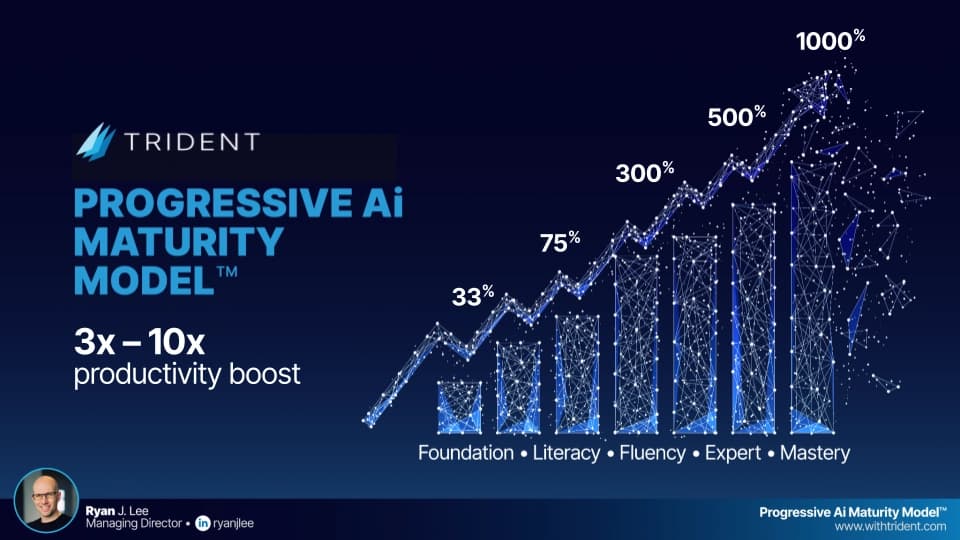
Here’s how to interpret each level:
- Foundation — familiarity with one model and using it to help and improve work
- Literacy — understanding the strengths and applications of different frontier models
- Fluency — generating high-quality prompts that produce near-full work products
- Expert — leveraging agents as specialists to delegate work streams
- Mastery — business processes run by an orchestrator with several sub-agents
What the levels unlock—for individuals and teams
For the individual, PAiMM™ replaces vague “get good at AI” advice with a ladder you can actually climb. Each level names the next skill to build—one model, then model choice, then repeatable prompts, then delegated agents, then orchestrated workflows—so progress is visible in your output, not hidden in hours spent. That clarity protects career relevancy: you know what “good” looks like this quarter, what to practice next, and how to stay in the same seat while the work around you compresses.
For the team, the same levels create a shared language across product, engineering, operations, finance, and GTM. Leaders can set expectations by function—“we need literacy in ops, fluency in product, expert in platform”—instead of one undifferentiated copilot rollout. Progress becomes measurable: who is still at foundation, who can delegate with agents, where an orchestrator can run a playbook end to end. The organization stops depending on a handful of power users and starts composing capability on purpose—fewer handoffs, faster cycles, and business at the speed of thought when the whole team moves up the curve together.
This brief opens the case for organization-wide AI fluency, places AI alongside the PC and Internet as a workforce mandate, and documents several cautionary arcs, from marketplaces to home entertainment. Coming next: a deeper pass on PAiMM™ stages, pilot purgatory, and how HR, technology, and line-of-business leaders align on one implementation plan.
Curated reading
Relevant links
- ChatGPTFrontier conversational AI for drafting, analysis, and everyday knowledge work.
- ClaudeFrontier model family tuned for reasoning, long documents, and careful instruction-following.
- GrokAssistant built for real-time information and fast iteration on open-ended questions.
- GeminiMultimodal frontier models integrated across Google’s productivity and developer surfaces.
- LlamaOpen frontier model family for self-hosted, fine-tuned, and embedded AI applications.