
How to make your "vibe coded" prototype production ready
Vibe coding can sell the idea. Production rewards platforms built with purpose—especially when AI has increasingly equipped sophisticated attackers.
Vibe coding is the fastest way founders have ever turned an idea into a working product demonstration. Prompt the interface, generate sample data, connect a few workflows, and you can put something tangible in front of a customer or investor within days—that is real leverage.
The mistake is allowing a successful prototype to quietly become the production system.
A prototype only has to demonstrate that an idea can work. A production platform must protect customer data, enforce permissions, recover from failure, withstand abuse, support audits, and remain dependable as usage grows. Those are fundamentally different engineering requirements.
This article explains where vibe coding creates the most value, where it becomes dangerous, and what must exist beneath the interface before a prototype is trusted with real users, payments, or sensitive information.
What vibe coding is actually for
Lean into it. Compress narrative to demo, validate positioning, and show the workflow before you spend a year assembling infrastructure. Treat the output as a pitch artifact with working screens—not the system of record for customer data, payments, or secrets. The fastest way to sharpen a product is to put a working concept in front of prospective users.
- Sell the story: a walkthrough beats a deck when the product comes to life
- Learn the ICP: watch where demos stall—those stalls are product and GTM signal
- Compress fundraising: investors underwrite conviction; a prototype creates it
- Prove the concept: don't prematurely optimize; reinvent tenancy and scale later
That can help founders reach term sheets faster and validate ICP and GTM with real buyers. Case in point: at a previous startup, we secured our first funding commitment with a functional end-to-end demonstration. Fifteen minutes in, the investor said, "Stop! That's all I need to see, you'll have a term sheet in 24 hours."
A Production Stack Is More Than a Frontend and Backend
Don't run afoul of the vibe coding blind spot: full-stack means frontend plus backend. Two big blocks. Ship the UI, wire a CRUD API, point it at a database—done. That is how prototypes get sold. It is not how platform-level systems stay up, stay secure, or stay trusted.
A prospective client once asked why they should not pay a friend a couple of thousand dollars to vibe-code and publish their app. Fine for a prototype; dangerous as production. When I asked about encryption, authentication, tokenization, and the cost of telling customers their data was compromised, the gap between a production-grade system and a demo became obvious—without needing a scare tactic.
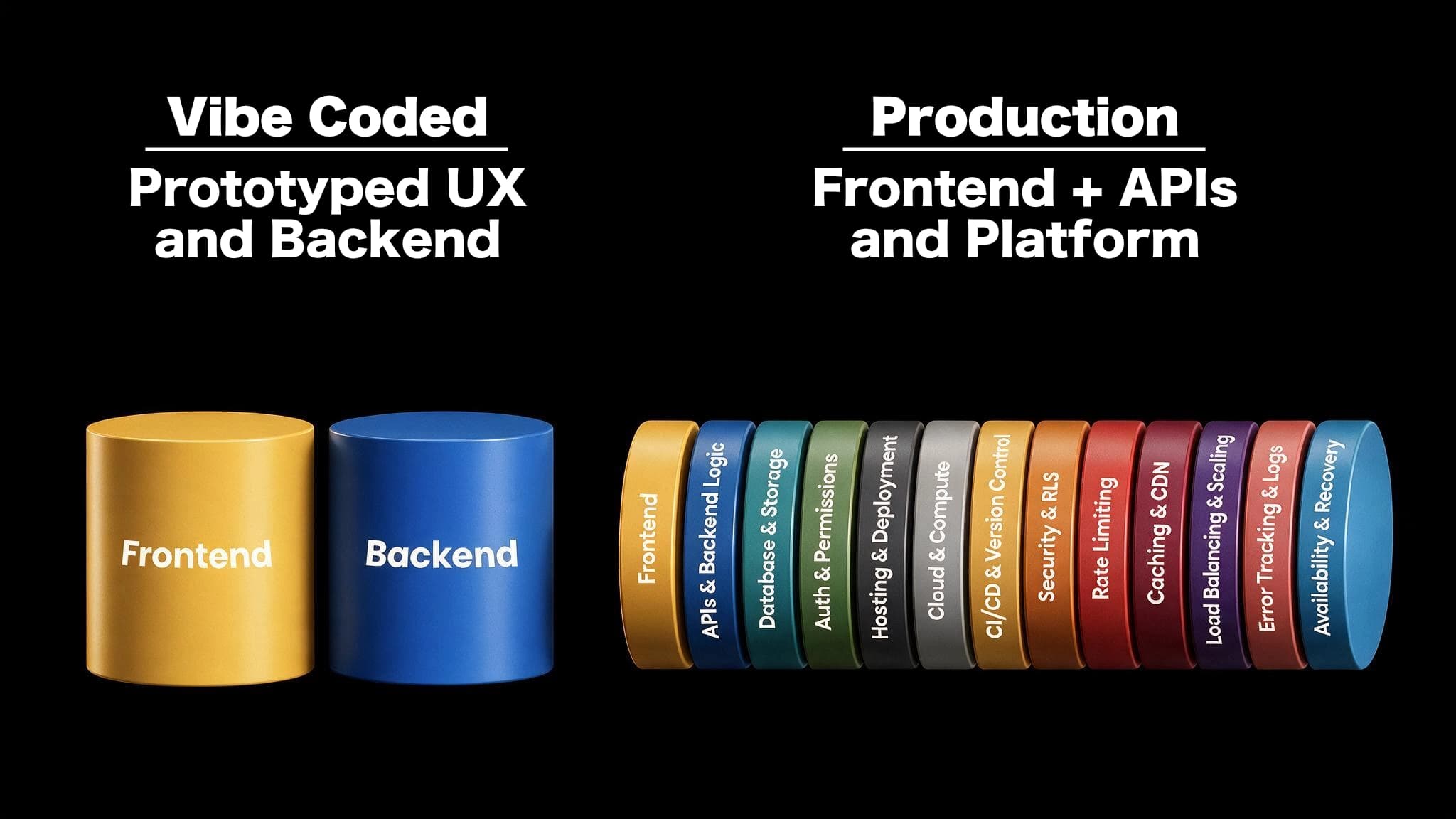
A true production backend is not “some API routes.” It is an event-driven system with hardened APIs, security built in, authentication and authorization, tokenization, encryption, and a production-grade database—plus hosting, CI/CD, rate limiting, caching, scaling, observability, and recovery. Skip those layers and you shipped a demo that happens to accept real traffic.
Where prototypes break in production
Production quality is not “prettier UI.” Vibe-coded stacks often skip the layers that keep a business alive when the happy path ends—because models optimize for visible progress, not adversarial load.
- Auth theater: Login that works in the demo, with weak session handling, no MFA story, and roles bolted on later
- Token and secret leakage: Keys, tokens, and credentials in the client because “it worked locally”—no proper tokenization boundary
- Unhardened APIs: Endpoints without authz checks, schema validation, or abuse controls—easy to scrape, fuzz, and escalate
- Database as a spreadsheet: No tenancy or row-level security, weak encryption posture, and recovery nobody has rehearsed
- No event spine: Synchronous happy paths only—no durable events, retries, or audit trail when something fails mid-flight
- Silent failure: No rate limits, no alerting, no way to answer “what happened?” after an incident
Attackers Are Using AI, Too
AI has not only democratized software development. It has also expanded access to sophisticated offensive capabilities—enumerating weaknesses, phishing, fuzzing APIs, and automating reconnaissance at a pace manual red teams never matched. Industrial-scale systems with real security budgets still get breached. A weekend prototype with a public API and early customer data is not “too small to matter.” It is low-hanging fruit. You do not need to become a security company overnight—but you must stop shipping customer trust on rails that were never designed for production rigor.
A prototype sells the idea. A backend earns the right to hold the data.
All Things AI
Sell with vibe. Run on production-ready rails
Lean into vibe coding to sell the idea—then put the product on a full-stack platform-as-a-service that already ships the foundational capabilities of a secure, scalable system. Keep AI-assisted velocity on the experience layer. Stop treating “we prompted a backend” as hardened infrastructure. When someone says a prototype is “production ready,” ask which of these seven layers they actually shipped:
- Identity: Authentication, sessions, MFA, and account recovery
- Authorization: Roles, permissions, tenancy, and row-level security
- Data protection: Encryption, tokenization, secret management, retention, deletion, and privacy or compliance obligations
- Application security: Validation, hardened APIs, automated testing, code and dependency scanning, source control and review, and rate limiting
- Reliability: Queues, durable events, retries, idempotency, and failure handling
- Operations: Separate development, staging, and production environments; CI/CD; infrastructure as code; database migrations; logging, monitoring, and alerting; rollback; cost and capacity controls; and incident response
- Resilience: Backups, disaster-recovery testing, scaling, and third-party dependency continuity
Before you put real users on it
If you cannot check a row, you are still running a prototype—no matter how polished the UI looks.
- Automated testing: Critical paths covered before every release
- Code and dependency scanning: Vulnerabilities caught in review, not after breach
- Source control and review: Changes are reviewed, attributed, and reversible
- Environment separation: Development, staging, and production are not the same database
- Database migrations: Schema changes are versioned, tested, and roll-forward safe
- Infrastructure as code: Environments are reproducible—not tribal knowledge on one laptop
- Rollback procedures: You can undo a bad deploy without improvising under pressure
- Disaster-recovery testing: Backups exist and restores have been rehearsed
- Data retention and deletion: You know what you keep, for how long, and how to erase it
- Privacy and compliance: Requirements match the data and markets you actually serve
- Third-party dependency risks: Vendors and libraries are inventoried and replaceable
- Cost and capacity controls: Usage, spend, and scale limits are watched before they surprise finance
Those capabilities are product features of the platform, not tickets for after Series A. Keep AI for velocity on the experience layer and proven rails for the trust layer—so a demo never accidentally becomes production.
Curated reading
- OWASP Top TenThe baseline risk categories production apps still fail—injection, broken access control, and more.
- NIST Cybersecurity FrameworkGovern, identify, protect, detect, respond, recover—language boards and buyers already expect.
- The Twelve-Factor AppClassic discipline for config, backing services, and disposability—still the anti-prototype checklist.
- Poseidon marketplace platformExample of full-stack marketplace rails—auth, vendors, orders, and payouts without reinventing the platform.
Further reading
- What is a business operating system and why nowWhy tailor-made operating layers are cheaper to build—and still need real workflow and governance rails.
- Don't conflate automation with AISpeed without orchestration creates cost and risk—the same pattern shows up in vibe-coded backends.
- Understanding fundraising: a look beyond the headlinesPrototype conviction helps you raise—delivery and infrastructure still have to pay the performance debt.